Case Study: How Voight Runs 230+ AI Agents on Dedicated Nosana GPUs (2026)
One click puts each AI agent on its own Nosana GPU, renewed by the hour and verifiable on Solana. Three months of real numbers, from deploy to cost.

On this page
- The challenge: agents shouldn't need someone else's model API
- The solution: one click, one agent, one GPU
- Built around the hour: pay for the hours an agent actually works
- A public identity tied to real compute
- Results: three months on Nosana, in numbers
- One real job, end to end
- Why Nosana worked for us
- Beyond hosting: Nosana across the Voight platform
- Run your agent on its own GPU
How Voight runs AI agents on dedicated Nosana GPUs with the model inside the job: deployed in one click, renewed by the hour while in use, and verifiable by anyone on Solana.
| At a glance | |
|---|---|
| Company | Voight, a platform to deploy, run and observe AI agents |
| Built on | Nosana Deployments API, Nosana credits, GPU markets and Nosana Explorer, plus the Metaplex Agent Registry |
| GPUs | NVIDIA RTX 3060, 5070, 3090 and 4090 |
| Model | Hermes 3 8B, running locally on the GPU |
| Live since | August 2026 |
| Results | 230+ agents, 341 GPU jobs, 870 GPU hours, 229 on-chain agent identities, 99.8% of test requests answered |
Challenge. Give each AI agent private, dedicated inference without per-token bills, without an API key inside the agent, and at a price that works for a single agent.
Solution. One click in the Voight dashboard puts an agent on its own Nosana GPU, with the model running inside the job. Jobs renew by the hour while the agent works and stop when it doesn't.
Results. More than 230 agents, 341 jobs and 870 GPU hours in three months, about $140 of compute at today's prices, and 229 agents with a public on-chain identity tied to real GPU work.
The challenge: agents shouldn't need someone else's model API
Most AI agents depend on a hosted model API. That has three costs. Every token is billed. An inference key has to live inside the agent, where it can leak. And every conversation travels to a model provider.
We wanted a second option for Voight users: an agent with its own GPU, running an open-weights model locally, where inference never leaves the machine and nobody pays per token. The obstacle was price. A cloud GPU for every agent, billed around the clock, does not work for one person's agent.
Nosana changed the math: a marketplace of consumer and workstation GPUs, rented by the hour, refunded by the second, with every job recorded on Solana.
The solution: one click, one agent, one GPU
Deploying an agent in Voight includes a Hosting step. Pick Nosana GPU, pick a market, and the agent comes up on its own GPU a few minutes later. There is no CLI, no Dockerfile and no job definition to write: the platform packages, validates and launches everything through Nosana's Deployments API.
- The model lives in the job. The container runs the Hermes agent runtime next to Hermes 3 8B, served locally with a 64K context window. There is no inference API key in the container.
- A stable address. Each deployment gets an HTTPS URL that keeps working when the job behind it changes, so chat, Telegram and other channels never reconnect.
- Memory outside the job. The agent's memory is restored when the GPU comes up and saved during the session, so a new job continues where the last one stopped.
- Live capacity. The deploy wizard shows how many GPUs are free in each market, read straight from the market's queue on Solana.
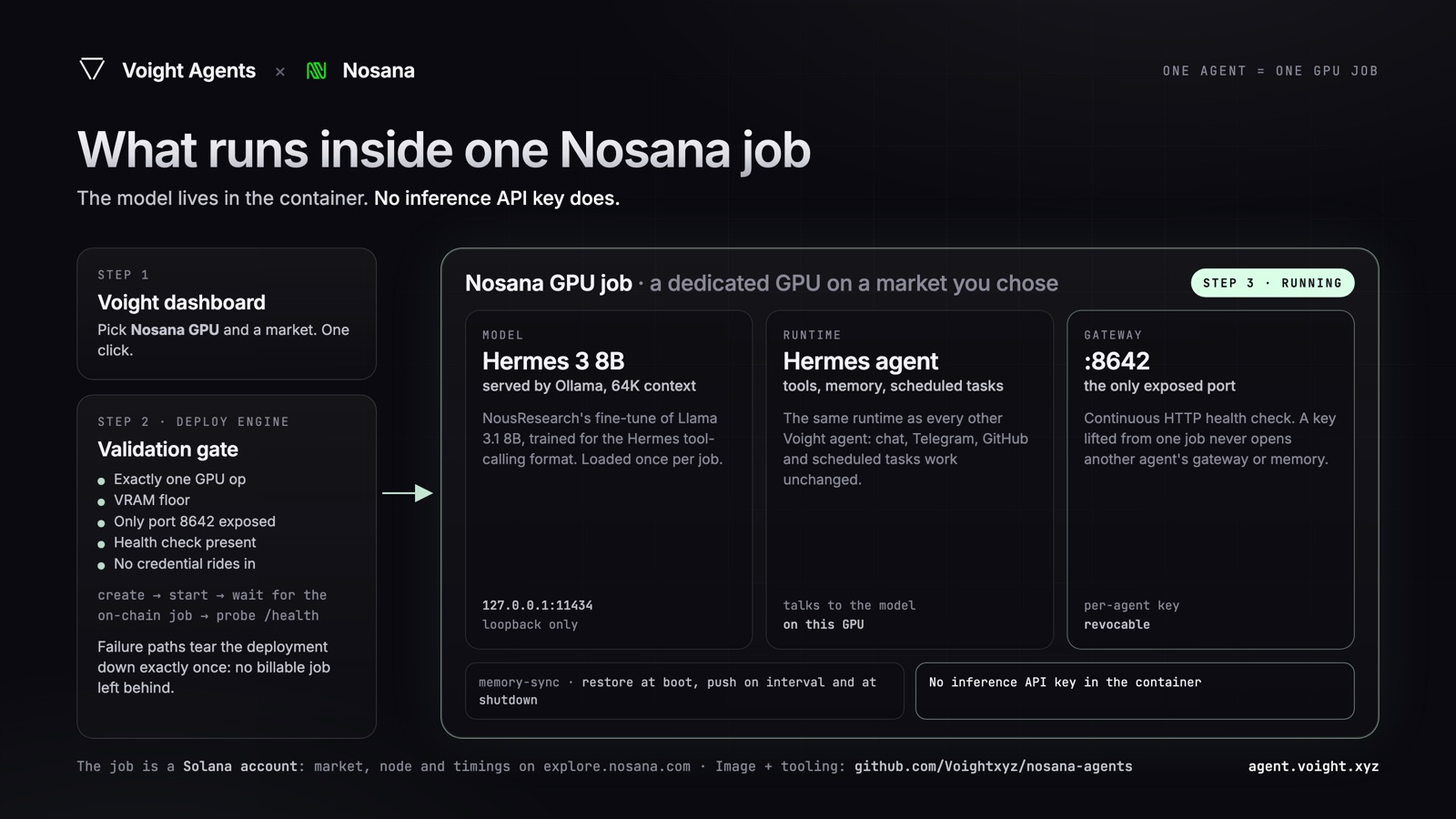
What runs inside one Nosana job. The deploy engine validates the job before it is posted: one GPU operation, a VRAM floor, a single exposed port with a health check, and no credentials inside.
Built around the hour: pay for the hours an agent actually works
Nosana rents GPU time by the hour, and Voight builds each agent's life around that hour. A running job can be extended, so an agent in use keeps the same GPU without a restart. An idle agent lets its job end and stops costing anything, while its identity, channels and memory stay in place.
- In use: renewed in place. Before the hour ends, if the agent was active recently, Voight extends the same job. Same GPU, nothing restarts.
- Idle: the GPU is released. With no activity, the job ends at the hour and billing stops. A daily cap keeps a forgotten agent from running forever.
- Stopped: woken on demand. A message, a Telegram ping, a scheduled task or the Wake up button starts a new job in a few minutes.
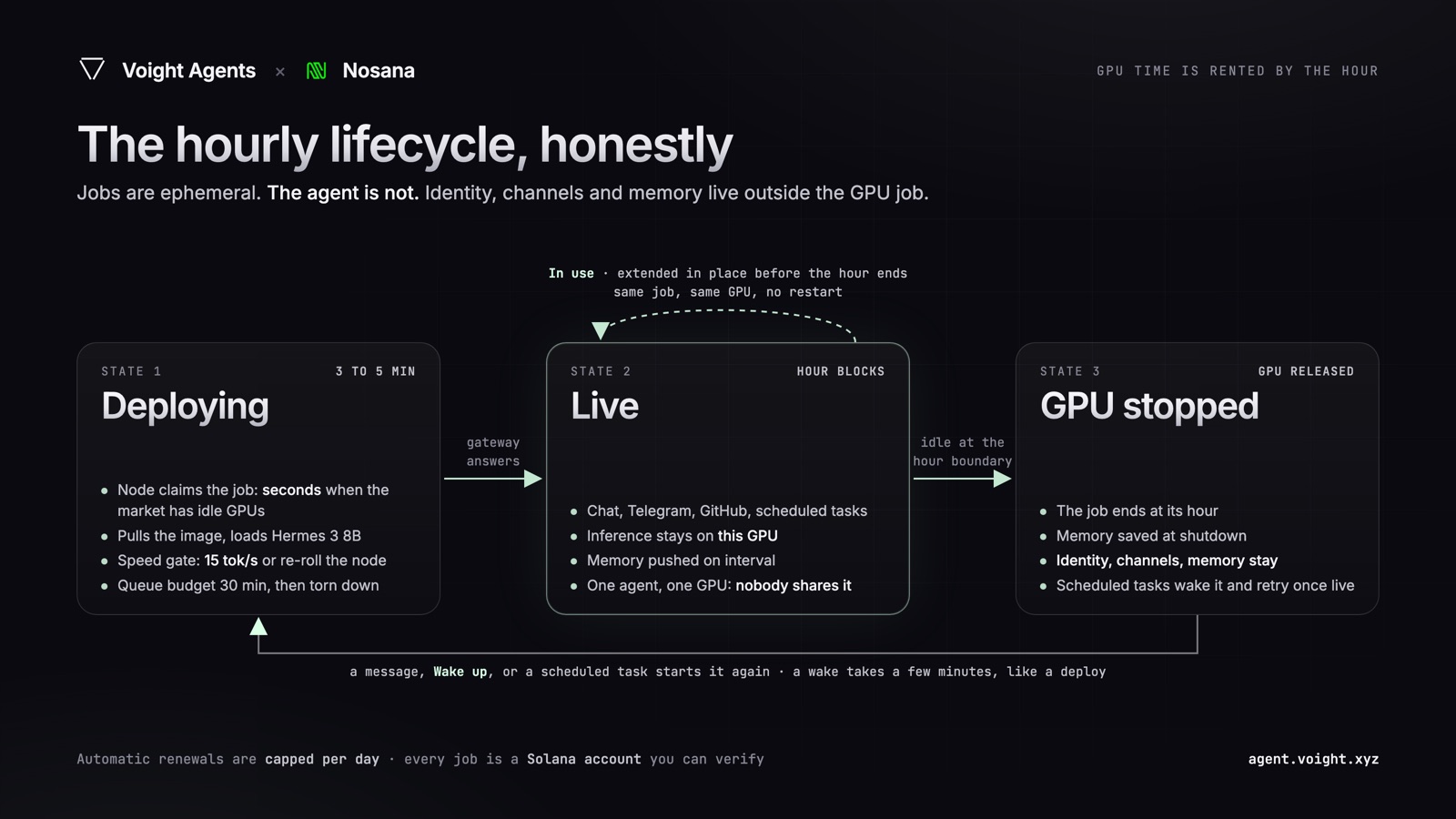
The lifecycle of a Voight GPU agent. Every job in it is a Solana account anyone can open.
A public identity tied to real compute
Every GPU agent on Voight gets its own identity in the Metaplex Agent Registry on Solana. The entry carries a Nosana GPU job service that links to that agent's own job on Nosana: market, host and timings, open to anyone. 229 GPU agents are registered this way, each linked to its own job, with no link repeated.
This is only possible because Nosana jobs are public. "This agent runs on its own GPU" is not a claim on a website: anyone can open the job and check it.
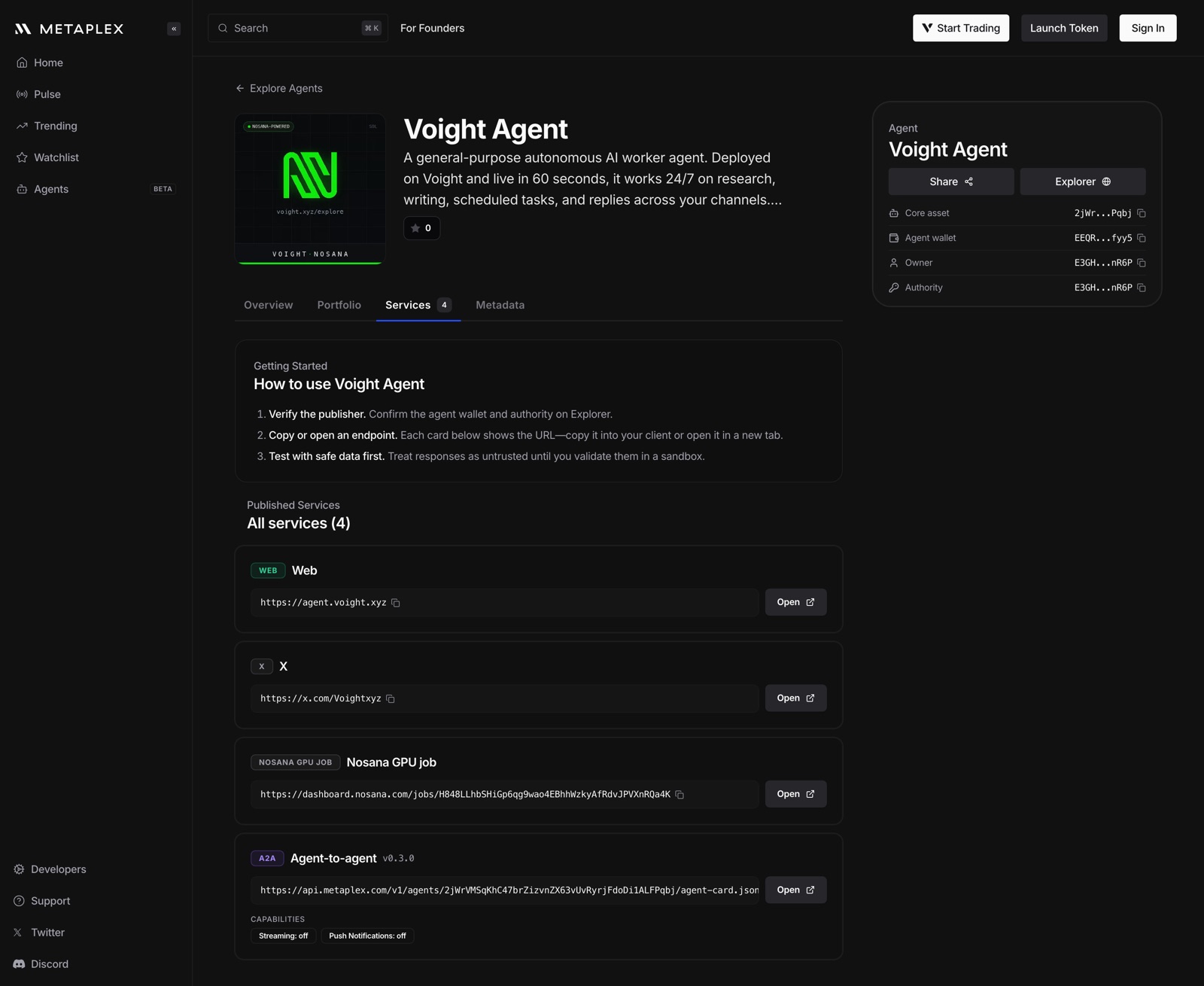
A Voight GPU agent in the Metaplex Agent Registry. The Nosana GPU job service opens the job that agent ran on.
Results: three months on Nosana, in numbers
From August 20 to November 19, 2026, more than 230 Voight agents ran 341 jobs and 870 GPU hours on Nosana. At today's market prices that compute costs about $140, roughly $0.16 per GPU hour on average.
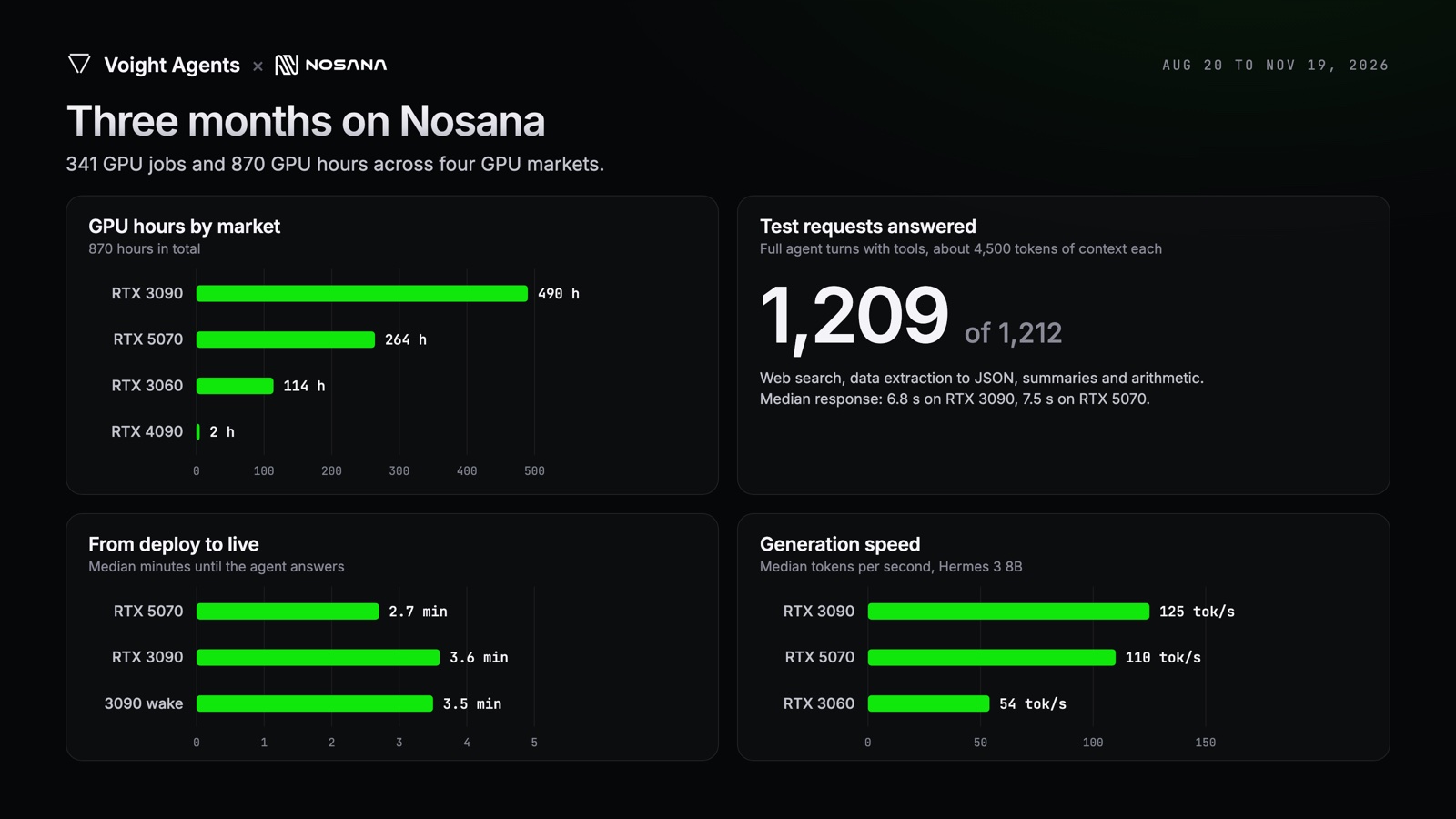
| Measure | RTX 3090 | RTX 5070 | RTX 3060 |
|---|---|---|---|
| GPU hours | 490 | 264 | 114 |
| From deploy to live (median) | 3.6 min | 2.7 min | too few deploys |
| Generation speed (median) | 125 tok/s | 110 tok/s | 54 tok/s |
| Response time per agent turn (median) | 6.8 s | 7.5 s | 14.6 s |
The RTX 4090 market, added in November, accounts for the remaining 2 GPU hours. Waking a stopped agent on an RTX 3090 took a median of 3.5 minutes. Of 1,212 test requests (full agent turns with tools, about 4,500 tokens of context each, covering web search, data extraction to JSON, summaries and arithmetic), 1,209 were answered.
Hours and jobs: Voight's GPU billing records, cross-checked with Nosana's public job API. Deploy times, speed and answers: 1,212 requests sent to Voight agents on Nosana GPUs in November 2026.
One real job, end to end
One Voight agent's job: posted to the RTX 3090 market, picked up seconds later by a host in Norway, extended twice while the agent was in use, and finished after 3 hours. Total: $0.52 plus a $0.05 network fee. Every step is a Solana transaction, and the job page needs no login.
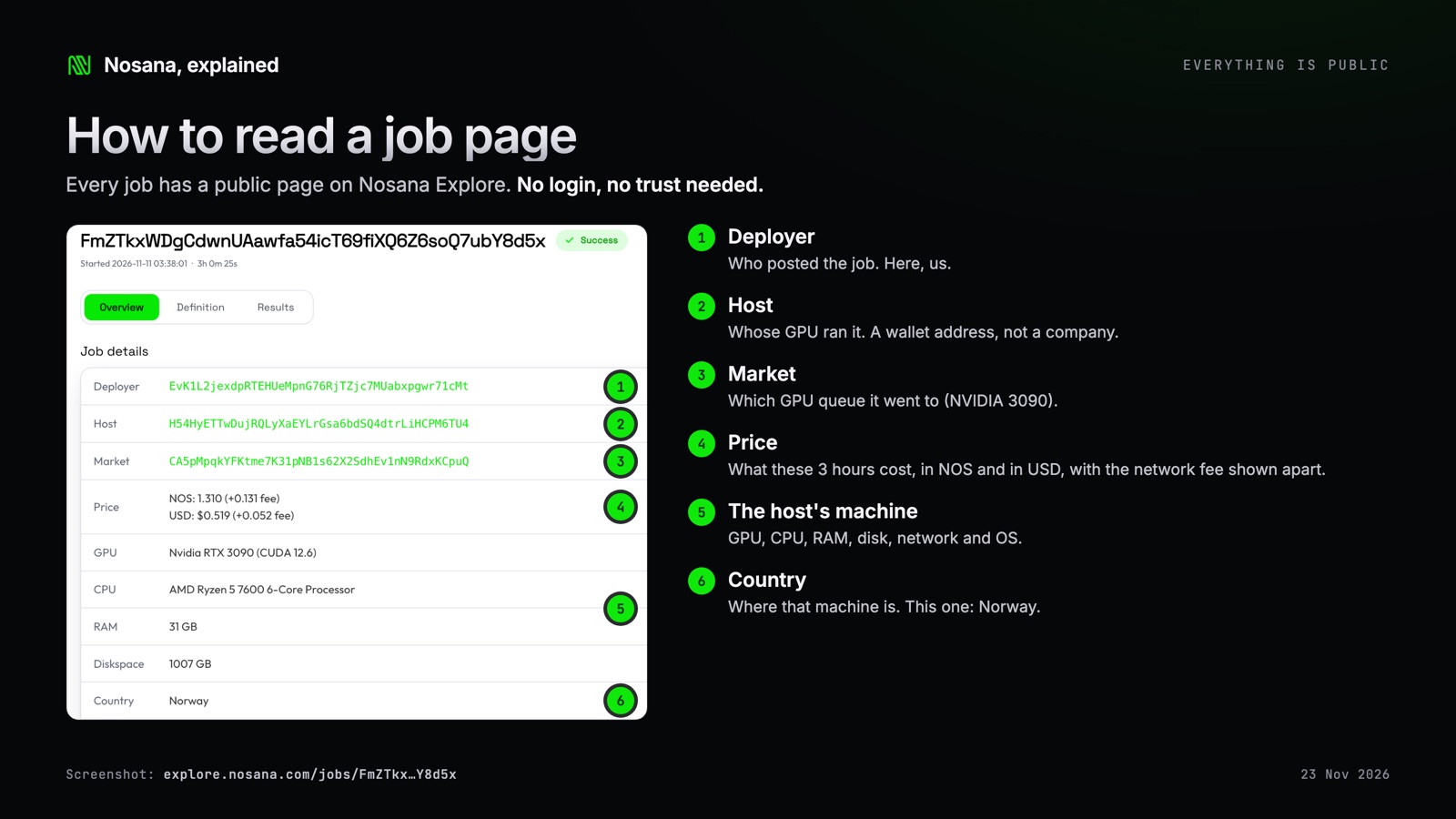
The job page: who posted it, which host ran it, the market, the machine and the price.
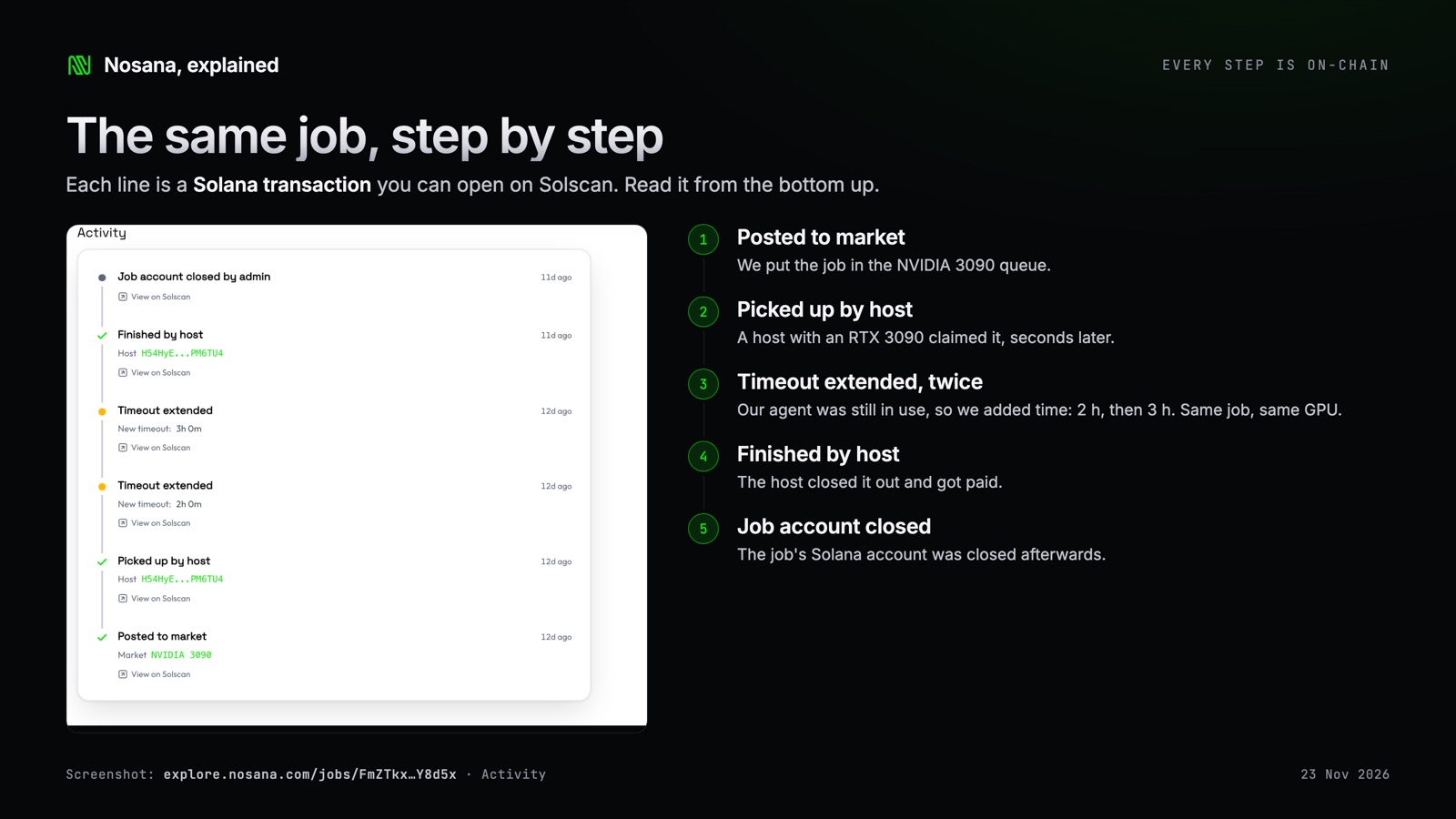
The job's activity: posted, picked up, extended to 2 and 3 hours, finished.
Open it yourself: explore.nosana.com/jobs/FmZTkxWDgCdwnUAawfa54icT69fiXQ6Z6soQ7ubY8d5x
Why Nosana worked for us
Seven things about Nosana shaped how Voight's GPU hosting works today.
- The whole lifecycle is an API. Create, start, extend and stop are API calls with a key. That is what turned a GPU deployment into a single click in our dashboard.
- Running jobs can be extended. That one endpoint makes "renew while in use" possible without restarting the agent or moving it to another machine.
- Pay for what you use. Time is reserved by the hour, and unused time is refunded by the second when a job stops.
- Stable URLs. A deployment keeps its HTTPS address across jobs, so users and channels never have to reconnect.
- Everything is verifiable. Jobs, hosts and payments live on Solana, which let us tie every agent's on-chain identity to real compute.
- Choice of hardware. 48 markets today, from 12 GB consumer cards to H100s, so each workload picks the cheapest card that fits. In November we added the RTX 5070 and RTX 4090.
- Consumer GPUs at consumer prices. An RTX 3060 costs less than five cents an hour, network fee included. Running a capable 8B model for a single agent becomes affordable, and the price is visible before a job is posted.
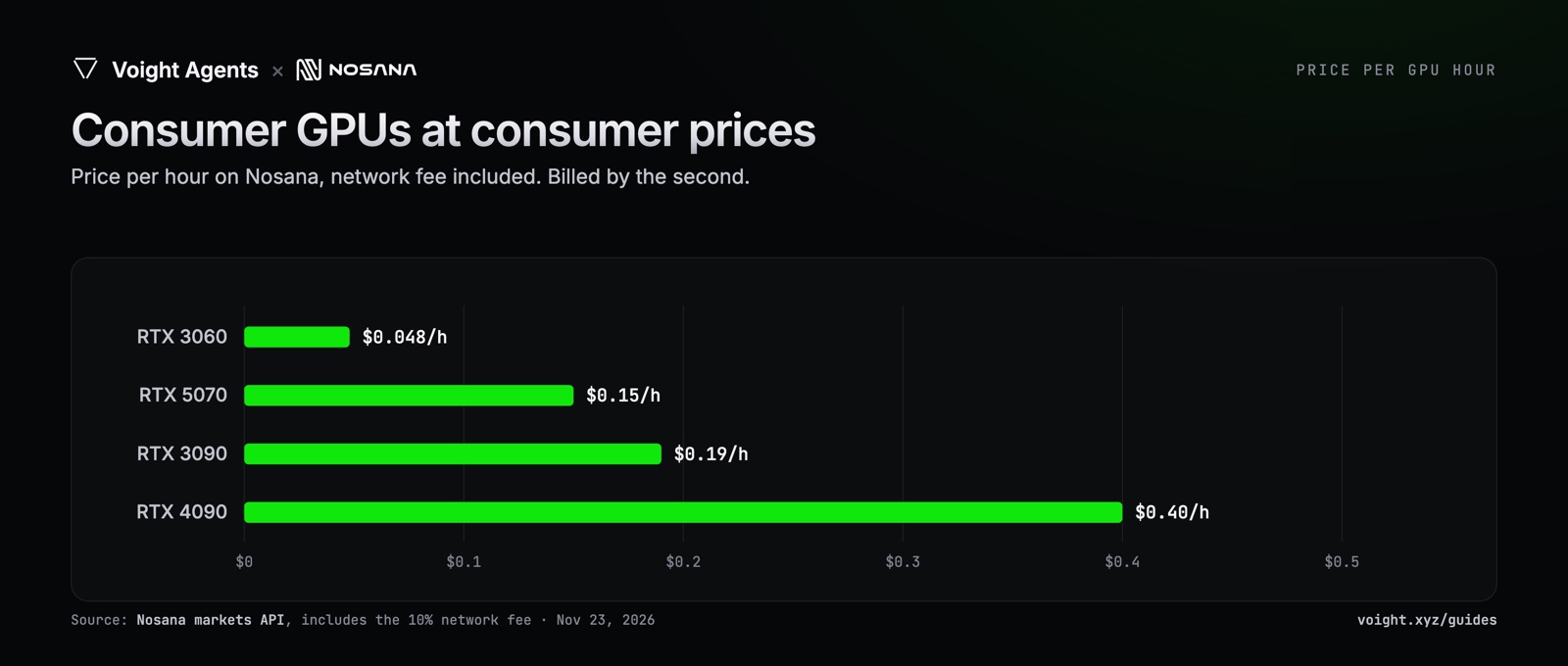
Price per hour on Nosana, including the 10% network fee, November 23, 2026.
Beyond hosting: Nosana across the Voight platform
- Pay in NOS. Voight users can top up their balance in NOS, Nosana's token, alongside USDC and SOL.
- Nosana-Powered agents. Agents that already run on Nosana can send telemetry to Voight. Voight detects the Nosana job automatically and marks them Nosana-Powered in its public explorer.
- A GPU agent to start. With theMiracle, new users can claim a free GPU agent with $20 of GPU hours included.
Run your agent on its own GPU
Deploy in one click, pick a Nosana market, and check every job on Solana.
- Deploy an agent: agent.voight.xyz
- Read the docs: docs.voight.xyz/agents/gpu-hosting
- Open-source image and tooling: github.com/Voightxyz/nosana-agents
- Watch the network live: explore.nosana.com
This work was supported by a Nosana grant and Nosana compute credits. Thank you to the Nosana team.